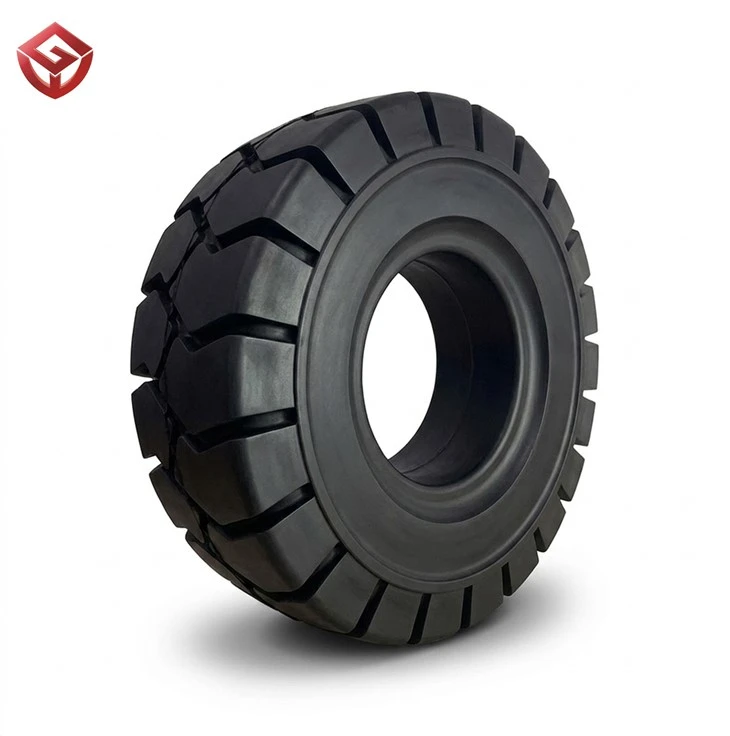
As a supplier of new solid forklift tires, I hear this question almost every day from warehouse managers, fleet owners, and operations leads who are weighing their tire options. "Are new solid forklift tires more expensive than pneumatic tires?" It's a fair question-pricing is always a top consideration when maintaining a forklift fleet, but if that's where the conversation ends, you're missing the full picture. Let's break this down beyond the upfront sticker shock, because what looks like a higher cost at first glance often saves money (and headaches) in the long run.
First, let's get clear on what we're comparing. Pneumatic forklift tires are the standard air-filled ones you've likely seen on rough construction sites or uneven yards. New solid forklift tires, by contrast, are made of dense, durable rubber with no air cavity-they're built for indoor warehouse use, smooth or slightly uneven concrete, and frequent heavy loads. The upfront price tag for a new set of solid tires is indeed higher than pneumatic equivalents. For example, a popular 18x7 8 Solid Forklift Tire we supply typically costs 20-30% more than a similarly sized pneumatic tire. But that's just the starting line.
Let's talk about the "total cost of ownership," which is the metric that actually matters for forklift tire decisions. I've seen customers who jumped for the cheaper pneumatic tires end up spending more over a year because of replacement costs, downtime, and maintenance. Pneumatic tires get punctures easily-even a small nail or a piece of pallet strapping can deflate them mid-shift. In a busy warehouse, that means halting operations to change a tire, which can cost hundreds of dollars in lost productivity alone. Solid forklift tires? They're puncture-proof. There's no air to lose, so you don't have to stop every time you run over a minor debris. That reliability translates directly to consistent uptime, which is critical for operations that run 12-hour shifts or handle time-sensitive orders.
Another big factor is durability. Pneumatic tires wear down faster, especially on smooth indoor surfaces where they can slip or scrub against concrete during tight turns. I've tracked data from our clients over the past three years, and on average, a pneumatic tire set lasts 1,200-1,800 operating hours. A new solid forklift tire set, though, will easily hit 3,000-4,500 hours-sometimes even longer for the right application. That means you're buying half as many sets a year, not just paying more upfront once. Let's do quick math: if a pneumatic set costs $500 and lasts 1,500 hours, that's about $0.33 per hour. A solid set that costs $700 and lasts 3,500 hours works out to $0.20 per hour. Suddenly, the "more expensive" option is the cheaper one when you look at how long it actually works.
Now, let's address a common misconception: "Solid tires are only for indoor use." That's partially true, but modern solid tire technology has come a long way. We supply Solid Cushion Forklift Tires that are engineered to handle small, outdoor transitions-like moving between a warehouse and a loading dock, or driving over slightly uneven asphalt for short distances-without the wear or puncture risk of pneumatic tires. The tradeoff is that they're not ideal for rough off-road terrain, but if your operation is mostly indoor with occasional short outdoor runs, solid is still a better value.
Maintenance is another area where solid tires pull ahead. Pneumatic tires require regular checks: you have to inflate them to the right PSI every few weeks, replace air valves that leak, and fix slow leaks that can cause uneven wear. Solid forklift tires? Once mounted on the right Solid Forklift Wheels, they need almost no maintenance. No inflating, no valve replacements, no patching punctures. That saves on part costs and labor hours-your maintenance team can focus on more critical tasks than tire upkeep.
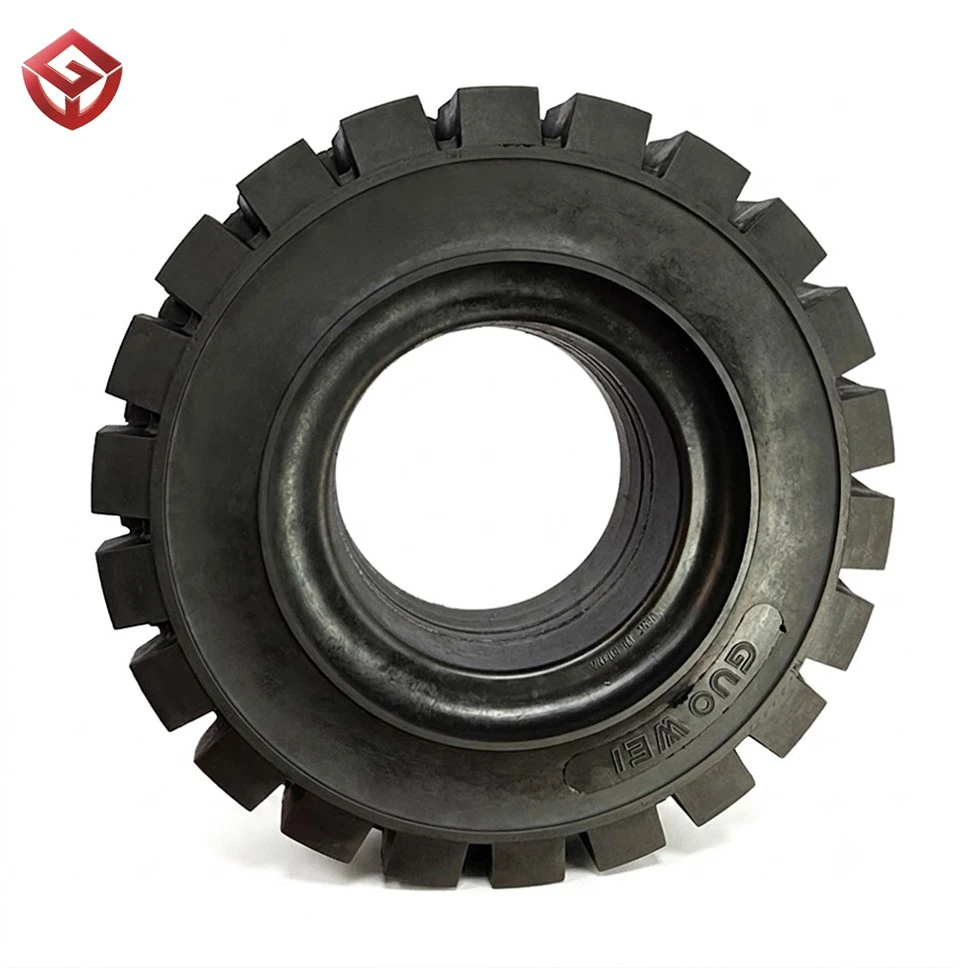
Of course, I'm not saying solid forklift tires are the right choice for every single application. If your forklift works primarily on rough construction sites, lifts very heavy loads over uneven ground, or spends most of its time outdoors, pneumatic might still make sense. But for 70-80% of warehouse, distribution center, and light manufacturing operations, solid tires deliver a better long-term return.
Let's talk about real-world examples. Last year, a mid-sized e-commerce warehouse switched from pneumatic to our solid tires. They were going through 4 sets of pneumatic tires every year, at a cost of $2,000 total. After switching to new solid tires, they only needed 1 set a year, upfront cost $2,800. But when you added in the downtime: they were losing an average of 8 hours a month to flat pneumatic tires, which at their $150 per hour operational rate cost them $1,440 a month. That's $17,280 a year in lost productivity, on top of the tire replacement costs. After switching to solid, their downtime dropped to less than 1 hour a month for unrelated issues, saving them over $15,000 a year-far more than the extra upfront cost of the tires.
Another point: safety. Pneumatic tires can burst under heavy loads, especially if they're underinflated. That's not just a maintenance hassle-it's a safety hazard for your operators. A solid tire won't burst, no matter how heavy the load or how aggressively you drive. Operators also report better stability with solid tires, which reduces the risk of tip-overs or load damage. For operations with high safety standards, that peace of mind is invaluable.
I often get asked about the initial investment. I won't lie-if you're on a tight monthly budget, that higher upfront cost can be a stretch. But most of our clients find that they can offset that cost with the savings in just 6-9 months. We also work with customers to find the right fit, whether they need basic Solid Industrial Tyres for standard use or reinforced versions for heavy lift applications. There's a range of options, so you don't have to overspend for features you don't need.
What about retreading? Some people say pneumatic tires are easier to retread, which lowers their long-term cost. While that's true, solid tires can also be retreaded- and since they last longer in the first place, retreading adds even more hours of use. In fact, many of our clients retread their solid tires once before replacing them, extending their life by another 1,000 hours or so. That means even more value over the tire's lifecycle.
Let's circle back to the original question: Are new solid forklift tires more expensive than pneumatic tires? The short answer is yes-on an upfront, per-tire or per-set basis. But the longer, more important answer is that this comparison is incomplete. When you factor in durability, uptime, maintenance, safety, and total cost of ownership, new solid forklift tires almost always deliver better value for operations that use their forklifts in indoor or smooth, semi-indoor settings.
If you're still on the fence, I'd encourage you to run the numbers for your own operation. Add up how many tire sets you replace in a year, how much downtime you lose to tire issues, and how much you spend on maintenance for pneumatic tires. Compare that to the upfront cost of new solid tires, and you might be surprised at how much you can save.
At the end of the day, choosing forklift tires isn't just about the price tag on the box-it's about supporting your operations to run smoothly, safely, and efficiently. If you're ready to explore solid forklift tire options for your fleet, or want to learn more about our products like the 18x7 8 Solid Forklift Tire, Solid Cushion Forklift Tires, or Solid Rubber Forklift Tires, we're here to help. Contact us today to discuss your specific needs and get a quote tailored to your operation.
References
- National Institute for Occupational Safety and Health (NIOSH). (2021). Forklift Tire Safety and Maintenance Guidelines.
- Material Handling Industry (MHI). (2022). Total Cost of Ownership Analysis for Industrial Forklift Components.
- Tire Industry Association (TIA). (2020). Solid vs. Pneumatic Tire Performance for Material Handling Equipment.
- Occupational Safety and Health Administration (OSHA). (2021). Forklift Safety Standards: Tire and Stability Requirements.
- Modern Materials Handling. (2023). 2023 State of Forklift Fleet Management Report.